

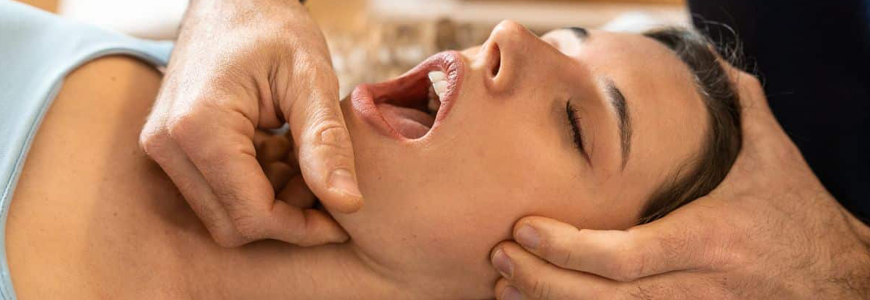
How Physiotherapy Treats TMJ Disorders
Treating the TMJ requires a highly specialized approach. A physiotherapist won't just look at your jaw; they will look at your neck, your posture, and your daily habits to get to the root of the dysfunction.
Comprehensive Assessment
Your physiotherapist will evaluate how your jaw opens and closes, checking for deviations, clicking, or limited range of motion. They will also assess your cervical spine (neck) and upper back, as poor posture is a massive driver of jaw pain.
Manual Therapy (Intra-oral and Extra-oral)
This is where TMJ physiotherapy stands out.
- Extra-oral Therapy: Massage and release of the tight muscles on the outside of your face, head, and neck (like the masseter and temporalis muscles).
- Joint Mobilization: Gentle, hands-on stretching of the jaw joint to improve its alignment and tracking.
- Intra-oral Therapy: With a gloved hand, the physiotherapist will gently massage the muscles inside your mouth (like the medial and lateral pterygoids). These are often the main culprits for a locked or clicking jaw, and they can only be reached from the inside.
Therapeutic Exercise
Once the muscles are relaxed, you need to retrain them to move the jaw correctly.
- Motor Control: Exercises that teach you how to open and close your mouth without the jaw shifting to one side.
- Postural Correction: Strengthening the deep neck flexors and upper back to pull your head out of a "forward head posture," which drastically reduces passive strain on your jaw.
Habit Modification
Many TMJ issues are fueled by unconscious habits. Your physiotherapist will help you identify and manage triggers like bruxism (teeth grinding), daytime jaw clenching, resting your chin on your hand, or sleeping in positions that compress the jaw.
Frequently Asked Questions
It can be uncomfortable, but it shouldn't be agonizing. The muscles inside your mouth are rarely massaged, so they can be quite sensitive—especially if they are in spasm. Your physiotherapist will communicate with you constantly to ensure the pressure is tolerable. Many patients report a strange, "good hurt" sensation followed by immediate relief and a looser jaw.
Often yes, but not always—and that's okay. Clicking usually happens when the small disc inside the TMJ slips out of place. Physiotherapy balances the muscle tension around the joint, which can help the disc track smoothly again and eliminate the click. However, even if a faint click remains, the primary goal of physiotherapy is to ensure your jaw is pain-free and fully functional. A pain-free click is generally considered harmless.
Almost certainly. The muscles that control your jaw are intimately connected to the muscles at the base of your skull and the front of your neck. When your jaw is tight from clenching or grinding, it sends tension directly into the head and neck, often triggering tension headaches, migraines, or a stiff neck. Treating the TMJ frequently resolves chronic headaches that haven't responded to other treatments.